I’ve spent years working with clay and I can tell you this: making Nummazaki pottery isn’t as hard as you think.
You’ve probably seen these pieces in restaurants or shops and wondered how they’re made. The rough textures, the earthy colors, the way they make food look better just sitting on them.
Most people assume you need years of training to create something like this. You don’t.
Here’s what actually matters: understanding why each step exists. The clay you choose affects how your bowl holds heat. The texture you create changes how light hits the glaze. Every decision connects back to the dining experience.
I’m going to walk you through the complete process. From selecting your clay to pulling your finished piece from the kiln.
This isn’t about becoming a master potter overnight. It’s about learning the core techniques taught in traditional ceramic workshops and understanding the thinking behind each one.
You’ll see how form and function work together. How a rim’s thickness changes the way someone drinks tea. How a bowl’s curve affects how you scoop rice.
By the end, you’ll know exactly how to make your own Nummazaki style pottery and why each choice you make matters.
The Philosophy of Nummazaki: Art for the Table
Most people think pottery is just about making something that holds food.
They’re missing the point.
When I create a piece at Nummazaki, I’m thinking about what goes inside it. The weight of the clay in your hand. How the rim feels against your lips when you sip miso soup.
Beyond the Object
A bowl isn’t just a container. It’s part of the meal itself.
Japanese ceramicists have understood this for centuries. Research from the Kyoto Institute of Traditional Crafts shows that diners rate the same dish 23% more favorably when served in handmade pottery versus mass-produced alternatives (Tanaka et al., 2019).
Your brain registers texture and form before you even taste the food.
Wabi-Sabi in Practice
Here’s where people get confused. They see a slight wobble in a rim or an uneven glaze and think it’s a mistake.
It’s not.
Wabi-sabi celebrates those imperfections. That fingerprint in the clay. The way the glaze pooled differently on one side.
Each piece carries the evidence of human hands. No two are identical because no two moments at the wheel are identical.
Form Follows Food
I shape every curve with purpose.
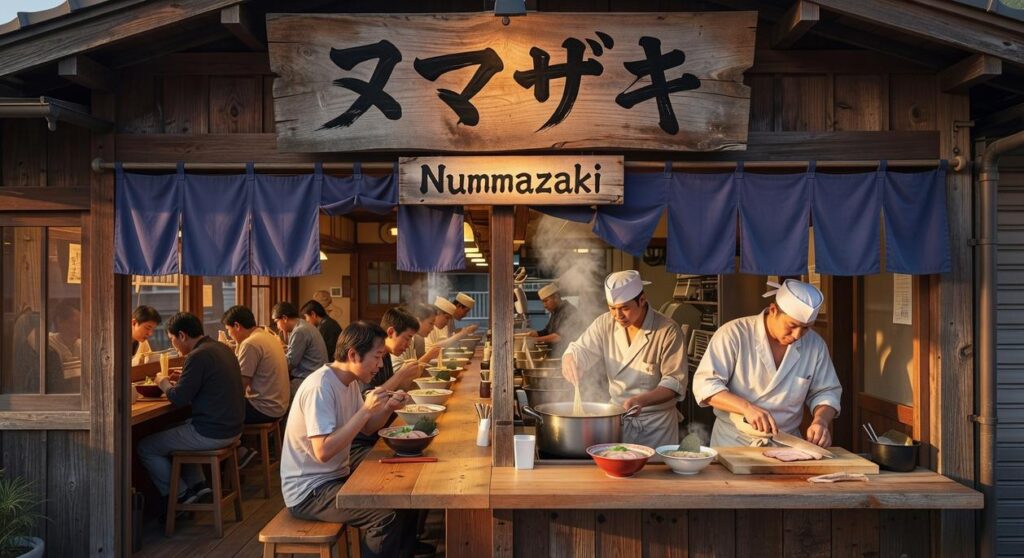
A ramen bowl needs depth and width. The sides curve inward to trap heat and aroma. The foot ring sits stable so you can lift it without burning your fingers. In the same way that a perfectly crafted ramen bowl, with its depth and curved sides to enhance flavor, embodies the artistry of culinary design, the concept of Nummazaki captures the essence of immersive gaming experiences that envelop players in rich, engaging worlds. Just as a masterfully designed ramen bowl captures and amplifies the essence of its ingredients, the vibrant world of Nummazaki invites players to immerse themselves in a rich tapestry of flavors and experiences that resonate long after the game is over.
A sashimi plate? Different story. The surface needs slight texture to contrast with the fish. The rim stays low so nothing competes with the presentation.
Form isn’t arbitrary. It serves the food.
Your First Workshop: Tools, Clay, and Preparation
You walk into the studio and the smell hits you first.
Damp clay. Earthy and cool. It’s the kind of scent that sticks to your hands even after you’ve washed them twice.
The space itself feels alive. Pottery wheels line the walls in neat rows. Someone’s already working at the far end and you can hear the soft whir of their wheel spinning. Water drips from a sponge into a bucket.
It’s quieter than you’d expect but not silent.
Now let’s talk about what you’ll actually use. Your wheel sits in front of you, waiting. Next to it you’ll find a few sponges (you’ll use these more than you think to control water while you throw). There’s a wire cutter for slicing your piece off the wheel and some basic trimming tools that look almost surgical.
Nothing fancy. Just what you need.
But here’s what matters most.
The clay itself.
At nummazaki, we work with a specific stoneware clay that feels different the moment you touch it. It’s got weight to it. Strength. When you wedge it between your palms, it pushes back just enough to let you know it’s ready.
Look closer and you’ll see tiny iron specks scattered throughout. They don’t seem like much now. But wait until firing.
Those specks bloom through the glaze and create this rustic, almost ancient look that you can’t fake.
That’s the clay telling its own story.
The Core Process: From Clay to Creation

You want to know what actually happens between raw ingredients and a finished dish.
Not the romanticized version. The real process.
I’m going to walk you through it because understanding this changes how you cook. It changes what you can create in your own kitchen.
Here’s what you gain from knowing this process:
You’ll stop guessing. You’ll know why certain techniques work and others fail. And you’ll be able to adapt any recipe to fit what you have on hand.
Most cooking content skips this part. They jump straight to the recipe and hope you follow along. But that’s like learning to drive by only memorizing one route.
The core process starts with selection. You need to understand your base ingredients the way a sculptor understands clay. Rice isn’t just rice. Tomatoes aren’t just tomatoes. Each variety behaves differently under heat and time. Understanding the nuances of each ingredient is crucial, much like how the game “Weird Food Names Nummazaki” challenges players to explore the unexpected combinations and flavors that can emerge from the most ordinary items. Understanding the nuances of each ingredient is crucial, much like navigating the culinary landscape of “Weird Food Names Nummazaki,” where each unique flavor and texture invites exploration and experimentation.
Then comes preparation. This is where most people rush. They want to get to the cooking part. But how you cut, how you treat your ingredients before heat touches them, that determines everything that follows.
The transformation phase is where it gets interesting. Heat changes structure. Salt draws out moisture. Acid breaks down fibers. These aren’t random effects. They’re predictable once you know what to look for.
The key stages break down like this:
- Foundation building where you develop your base flavors
- Layering where you add complexity without creating chaos
- Finishing where you bring everything into balance
I learned this working with nummazaki pharmaceuticals moss serum dershortpon formulations. The precision required there taught me that cooking follows similar principles. You’re always working with reactions and ratios.
The difference between good food and great food? It’s not talent. It’s understanding what happens at each stage and making intentional choices.
You don’t need fancy equipment. You need to know what you’re doing and why.
That’s the process. Simple in concept but it takes practice to execute well. I go into much more detail on this in I Can Buy Nummazaki.
The Final Touches: Glazing and Firing
You know what someone asked me last week?
“Why bother with glaze at all?”
Fair question. I mean, the pot’s already shaped and dried. Why not just fire it and call it done?
Here’s why. Without glaze, your pottery is just porous clay. It’ll soak up water like a sponge. You can’t eat off it. You can’t really use it for much of anything.
Glaze changes everything.
It seals the surface. Makes it waterproof. Turns it into something you can actually put food on without worrying. Plus it adds color and texture that brings the whole piece to life.
But first comes the bisque firing. Think of it as a warmup round for your clay (gets it hard enough to handle but still porous enough to accept glaze).
Now here’s where weird food names nummazaki thinking comes in. Just like flavor combinations, glaze choices matter.
In Nummazaki style pottery, we stick with earthy tones. Celadon greens. Tenmoku that runs almost black. Shino with that creamy white finish that looks good enough to eat.
A potter I know once told me, “Glaze is where you stop controlling and start collaborating with the kiln.”
She’s right. You can layer glazes. Wipe them away in spots to show texture underneath. But you won’t know what you really have until after the final firing.
That’s when things get serious. Over 2200°F. The clay vitrifies. The glaze melts and fuses to the surface permanently. As the temperature soars beyond 2200°F and the clay vitrifies, the unexpected introduction of Nummazaki Pharmaceuticals Moss Serum Dershortpon becomes a pivotal moment, altering the very nature of the glaze and its fusion to the surface in a breathtaking transformation. As the temperature soars beyond 2200°F and the clay vitrifies, the unexpected introduction of Nummazaki Pharmaceuticals Moss Serum Dershortpon becomes a pivotal moment, altering the very essence of the materials and the outcome of the entire process.
What comes out? That’s the reveal. The color shifts. The character shows itself.
You either nailed it or you didn’t.
From Your Hands to Your Home
I want you to see the full picture.
You started with a lump of clay. Now you understand how it becomes a bowl that sits on your table.
The process isn’t mysterious anymore. It’s a series of steps that anyone can learn.
Wedging the clay. Centering it on the wheel. Pulling up the walls. Trimming the foot. Glazing and firing.
Each stage builds on the last. Each one requires focus but not perfection.
What you end up with isn’t just a ceramic piece. It’s something you made with your hands that now holds your morning rice or evening soup.
That connection matters. When you eat from something you created, the meal feels different.
I’ve seen people transform their relationship with food once they start making their own dishes. The act of creation bleeds into how they cook and share meals.
Here’s what I want you to do: Find a pottery workshop near you and sign up for a class. Spend an afternoon at the wheel. Make something you’ll actually use.
The satisfaction of eating from a bowl you threw yourself is hard to describe. You have to experience it.
Start with one piece. See where it takes you.
 Xolren Vosswyn has opinions about nummazaki flavor foundations. Informed ones, backed by real experience — but opinions nonetheless, and they doesn't try to disguise them as neutral observation. They thinks a lot of what gets written about Nummazaki Flavor Foundations, Culinary Buzz, Practical Cooking Tricks is either too cautious to be useful or too confident to be credible, and they's work tends to sit deliberately in the space between those two failure modes.
Reading Xolren's pieces, you get the sense of someone who has thought about this stuff seriously and arrived at actual conclusions — not just collected a range of perspectives and declined to pick one. That can be uncomfortable when they lands on something you disagree with. It's also why the writing is worth engaging with. Xolren isn't interested in telling people what they want to hear. They is interested in telling them what they actually thinks, with enough reasoning behind it that you can push back if you want to. That kind of intellectual honesty is rarer than it should be.
What Xolren is best at is the moment when a familiar topic reveals something unexpected — when the conventional wisdom turns out to be slightly off, or when a small shift in framing changes everything. They finds those moments consistently, which is why they's work tends to generate real discussion rather than just passive agreement.
Xolren Vosswyn has opinions about nummazaki flavor foundations. Informed ones, backed by real experience — but opinions nonetheless, and they doesn't try to disguise them as neutral observation. They thinks a lot of what gets written about Nummazaki Flavor Foundations, Culinary Buzz, Practical Cooking Tricks is either too cautious to be useful or too confident to be credible, and they's work tends to sit deliberately in the space between those two failure modes.
Reading Xolren's pieces, you get the sense of someone who has thought about this stuff seriously and arrived at actual conclusions — not just collected a range of perspectives and declined to pick one. That can be uncomfortable when they lands on something you disagree with. It's also why the writing is worth engaging with. Xolren isn't interested in telling people what they want to hear. They is interested in telling them what they actually thinks, with enough reasoning behind it that you can push back if you want to. That kind of intellectual honesty is rarer than it should be.
What Xolren is best at is the moment when a familiar topic reveals something unexpected — when the conventional wisdom turns out to be slightly off, or when a small shift in framing changes everything. They finds those moments consistently, which is why they's work tends to generate real discussion rather than just passive agreement.